
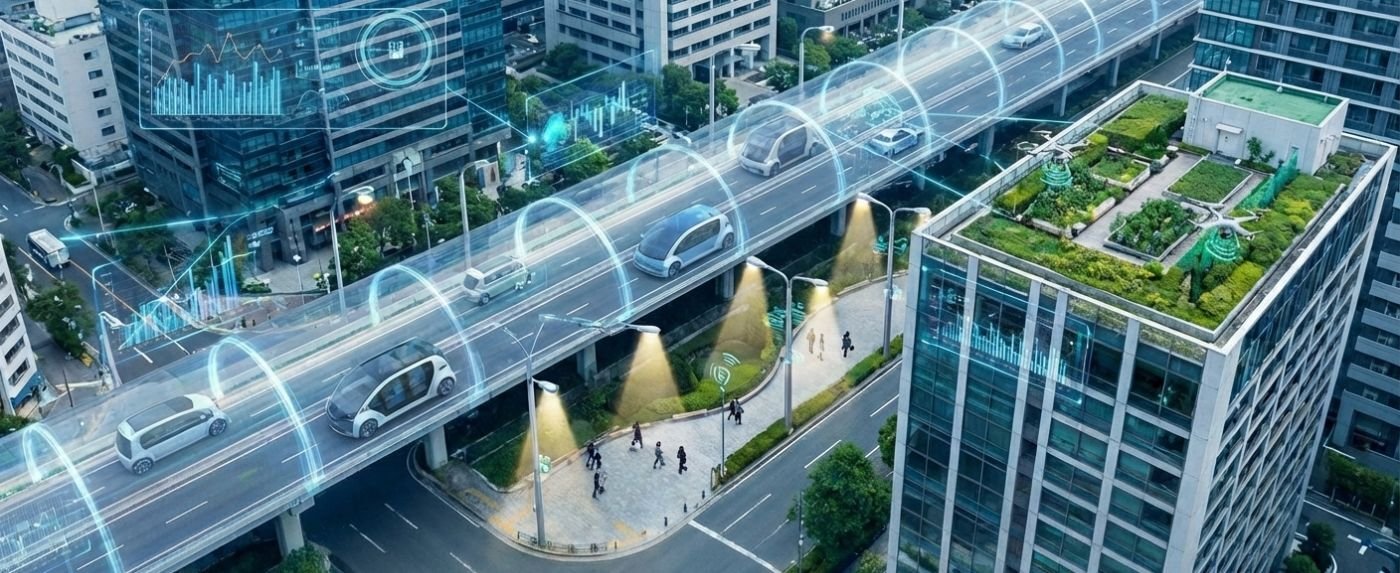
The rapid pace of global urbanization has created a pressing need for more efficient, sustainable, and resilient urban environments.
As cities swell in population, traditional infrastructure struggles to keep pace with the demand for resources, mobility, and safety. This is where smart city solutions come into play.
By leveraging the Internet of Things, artificial intelligence (AI), and high-speed connectivity, cities are evolving into connected urban environments that respond to the needs of their citizens in real-time.
Modern digital cities are no longer a concept of the future; they are a reality being built through urban technology solutions.
From intelligent urban data analytics to IoT-based urban applications, these innovations are fundamentally changing how we live, work, and interact with our surroundings.
Table of Contents
ToggleSmart Traffic Management Solutions
One of the most visible impacts of smart city solutions is in the realm of transportation. Traditional traffic systems are often reactive, but intelligent urban applications allow for a proactive approach to managing the flow of people and vehicles.
Reducing Traffic Congestion
Traffic congestion is more than just an annoyance; it is a significant drain on economic productivity and environmental health.
In connected cities and the internet of things, sensors embedded in roadways and GPS data from vehicles provide a constant stream of information.
Urban IoT solutions analyze this data to identify bottlenecks before they happen. By implementing IntelliPark systems, cities can guide drivers directly to available parking spots, reducing the “cruising” time that accounts for up to 30% of urban traffic.
AI-Based Traffic Signals
The transition from fixed-timer lights to AI-based traffic signals is a cornerstone of intelligent urban innovation. These systems use urban sensing technologies to monitor traffic volume at intersections in real-time.
Using intelligent urban data, the AI adjusts signal timing to favor the heaviest flow of traffic. The application of IoT in intelligent urban environments can reduce wait times at intersections by up to 40%, resulting in a significant reduction in fuel consumption.
Road Safety Improvements
Safety is a primary driver for IoT in modern urban systems. Connected infrastructure allows vehicles to communicate with the road itself (V2I).
For example, if a sensor detects ice on a bridge or a pedestrian in a blind crosswalk, it can send an immediate alert to approaching connected cars.
These real-world IoT urban use cases demonstrate how technology in connected cities saves lives by preventing accidents before they occur.
Energy-Efficient Smart Grids
The backbone of a sustainable city is its ability to manage power intelligently. The IoT role in intelligent urban energy distribution is vital for balancing supply and demand in an era of fluctuating energy prices.
Digital Energy Monitoring
Digital energy monitoring involves the use of IoT infrastructure for intelligent buildings and residential areas to track energy usage patterns.
By using intelligent urban data analytics, utilities can predict peak load times with high precision. This allows for better grid stability and prevents the brownouts often associated with aging digital urban infrastructure.
Renewable Energy Integration
Transitioning to green power requires sophisticated IoT technologies for connected cities. Unlike traditional power plants, renewable sources like wind and solar are intermittent.
Smart city solutions use intelligent urban connectivity to switch between energy sources seamlessly. This intelligent urban project using IoT ensures that when the sun is shining, the city maximizes solar intake, storing excess power in large-scale battery systems for later use.
Cost Optimization
For the end-user, IoT and connected cities mean lower utility bills. Smart grids allow for dynamic pricing, where electricity is cheaper during off-peak hours.
IoT-enabled urban applications can automatically run high-energy appliances (like dishwashers or EV chargers) when rates are lowest. This creates a win-win scenario for both the grid operator and the consumer.
Sustainable Energy Solutions
While the grid manages distribution, sustainable urban living depends on how we generate and consume energy at the local level.
Solar Power Systems
Modern urban technology solutions emphasize decentralized power. Photovoltaic (PV) panels integrated into intelligent buildings allow structures to generate their own power.
When combined with IoT and intelligent cities frameworks, these buildings can sell excess energy back to the grid, turning a cost center into a revenue generator.
Smart Energy Meters
The era of the manual meter reader is ending. Smart energy meters provide real-time feedback to both the consumer and the provider.
This is a key application of IoT in modern urban environments, as it encourages users to be more mindful of their carbon footprint.
These meters are a fundamental component of the urban IoT ecosystem, providing the data necessary for long-term urban planning.
Demand Response Technology
Demand response technology is an advanced IoT solution for intelligent cities. During extreme weather events, the grid can send signals to smart thermostats and appliances to temporarily reduce power draw.
This prevents grid failure without requiring any manual intervention from the resident. It is a prime example of how IoT for connected cities creates a more resilient society.
Smart Waste Management Technology
Waste management is often overlooked, but it is a critical component of urban technology solutions powered byIoTt. Traditional “static” collection routes are inefficient and costly.
IoT Waste Collection
By installing sensors for connected cities inside waste bins, municipalities can monitor fill levels in real-time. This IoT urban city application ensures that trucks only visit bins that are actually full.
Companies specializing in solutions for intelligent cities have found that this can reduce collection costs by as much as 50%.
Optimized Collection Routes
Using intelligent urban data, waste management software calculates the most fuel-efficient route for collection trucks.
This reduces the number of heavy vehicles on the road, decreasing noise pollution and wear-and-tear on city streets.
It is a practical application of intelligent urban development that yields immediate ROI for taxpayers.
Improved Recycling Efficiency
IoT-based urban applications are also being used at sorting facilities. AI-powered cameras and sensors can identify materials (plastics, metals, paper) more accurately than human sorters. This leads to higher purity in recycled materials, making the circular economy a reality within connected urban environments.
Smart Public Safety Solutions
Public safety is the foundation of any thriving community. Smart city solutions provide law enforcement and emergency services with the tools they need to act faster and more effectively.28
AI Surveillance Systems
While privacy is a key consideration in IoT security in connected cities, AI-powered surveillance can significantly deter crime.
These systems can automatically detect “unusual” patterns—such as a person falling or a crowd suddenly dispersing—and alert authorities.
Intelligent urban projects have successfully used these technologies to manage large public events and ensure pedestrian safety.
Emergency Response Technology
In an emergency, every second counts. Intelligent urban wifi solutions and intelligent urban 5G networks allow first responders to access building blueprints, medical records, and live video feeds while en route to a scene.
By integrating these advanced smart city technologies, municipalities create a robust connected cities IoT infrastructure. This ensures that paramedics and firefighters have the critical information they need before they even step out of their vehicles.
Disaster Management Systems
For cities prone to natural disasters, the Internet of Things for urban environments provides an early warning system. Sensors can detect seismic activity, rising floodwaters, or early signs of wildfires.
These IoT urban projects automatically trigger sirens, send push notifications to residents’ phones, and even shut down gas lines to prevent secondary fires.
Benefits of Smart Mobility
Smart mobility is about more than just moving cars; it’s about moving people efficiently and equitably. It is one of the most researched topics in urban innovation news.
Faster Urban Commuting
By integrating intelligent urban connectivity, cities can create a “seamless” transit experience. Imagine an app that combines bike-sharing, subway schedules, and autonomous shuttles into a single ticket.
This is how cities integrate intelligent mobility into planning, ensuring that public transit is always the fastest and most convenient option.
Reduced Carbon Emissions
Smart mobility is a major driver of reduced carbon emissions. By optimizing routes and encouraging the use of electric public transport, cities can drastically lower their environmental impact.
IoT and connected cities technologies allow for the management of electric bus fleets, ensuring they are charged and deployed where they are needed most based on live passenger demand.
Better Transport Accessibility
For many, the “last mile” of a commute is the hardest. Urban IoT applications like e-scooters and on-demand transit vans bridge this gap.
This improves accessibility for the elderly and those with disabilities, ensuring that the benefits of digital cities are available to everyone, regardless of their physical location or mobility status.
Feature | Traditional City | Smart City |
Traffic | Fixed timers, reactive | AI-controlled, predictive |
Energy | Centralized, fossil-fuel heavy | Decentralized, renewable-heavy |
Waste | Scheduled pickup | Demand-based pickup |
Safety | Reactive policing | Proactive AI monitoring |
Mobility | Fragmented transport | Integrated “Mobility as a Service” |
The Role of Infrastructure: 5G and WiFi
The “intelligence” of a city is only as good as its network. Intelligent urban 5G provides the low-latency communication required for autonomous vehicles and real-time remote surgery.
Meanwhile, wifi management for connected cities ensures that even in dense urban canyons, connectivity remains stable.
Internet of Things-connected cities rely on a mix of technologies. While 5G handles high-speed data, Low Power Wide Area Networks (LPWAN) are used for simple sensors, like those in water pipes or streetlights, which need to run for years on a single battery.
This multi-layered intelligent urban connectivity is what allows a city to truly “breathe” and respond.
Challenges and Considerations
While the benefits are clear, implementing IoT solutions for intelligent cities is not without hurdles:
- Data Privacy: How is resident data collected, and who owns it?
- Cybersecurity: IoT security in connected cities is paramount to prevent hackers from disrupting critical services.
- Digital Divide: Ensuring that urban technology solutions don’t leave behind low-income neighborhoods.
- Interoperability: Different IoT urban projects must be able to talk to each other to be effective.
Conclusion
The transformation of urban life through smart city solutions is an ongoing journey. As we integrate the Internet of Things for intelligent buildings, smart mobility systems, and sustainable urban living practices, our cities become more than just places to live—they become active partners in our well-being.
The future of the IoT-enabled urban application lies in its ability to make the invisible visible—turning raw data into actionable insights that improve the quality of life for every citizen.
Whether it is through intelligent urban data analytics or the simple convenience of a smart parking app, the connected urban environment is here to stay.
Frequently Asked Questions (FAQs)
1. What are the primary benefits of implementing smart city solutions?
Smart city technologies enhance urban life by reducing traffic congestion, lowering energy costs, and improving public safety through real-time intelligent urban data analytics.
2.How do IoT applications in intelligent cities improve public safety?
IoT and connected cities use urban sensing technologies to provide first responders with instant data and building blueprints via high-speed intelligent urban 5G networks.
3. Are smart city technologies secure from cyber threats?
Security is maintained through rigorous IoT security in connected cities protocols, including end-to-end encryption and secure digital urban infrastructure to protect citizen privacy.
4.How does a smart grid contribute to energy efficiency?
Smart grids utilize digital energy monitoring and smart energy meters to balance supply with demand, integrating renewable sources while optimizing costs for residents.
5. How do smart city solutions impact the environment?
These systems drive sustainable urban living by optimizing waste collection routes and reducing carbon emissions through IoT-enabled smart mobility and energy management.